Red seabream

No sign-up needed. You can save notes on this device.
An illustration based on the real animal.
A little discovery to share.
The red sea bream has strong, sharp spines in its dorsal fin.
THE REAL WORLD
The real Red seabream
- Scientific name
- Pagrus major
- Japanese name
- マダイ
- Group
- Ocean animals
- Order
- Spariformes
- Family
- Sparidae
- Genus
- Pagrus
Called the 'king of fish', it lives in coastal waters from southern Hokkaido to the South China Sea.
Its body is red, with small cobalt-blue spots scattered over the upper part of its sides.
Both of its jaws have well-developed molar teeth, and it mainly eats crustaceans such as shrimp and crabs.
How the Red seabream lives
From spring to summer, it grows in places such as seaweed beds in shallow coastal water. As the water cools in autumn, growing juveniles move to deeper water offshore. Adult red sea bream return to shallow water in spring to lay eggs.
東京都島しょ農林水産総合センターBasic data
- Size
- Total length: up to 100 cm
- Diet
- Crustaceans including shrimp and crabs
- Range
- Coastal areas from southern Hokkaido to southern Korea and the South China Sea
Where the Red seabream has been recorded
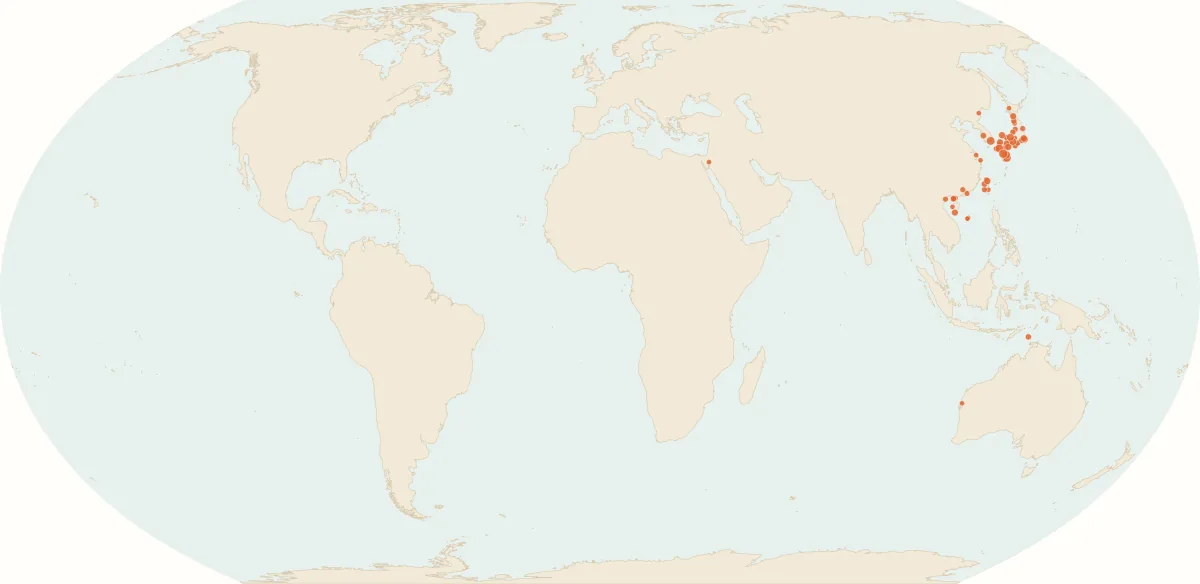
Records: GBIF.org (CC0 and CC BY 4.0 records, retrieved 2026-11-07). Map: Natural EarthSee the records on GBIF
Watch wild animals from a distance. Do not touch or feed them, and take care of the places where they live.
Names around the world
- 日本語
- マダイ
- 简体中文
- 真鲷
- 繁體中文
- 日本真鯛
- 한국어
- 참돔
- Español
- Dorada del Japón
- Français
- Dorade Japonaise
- Italiano
- Pagro maggiore
- Русский
- Красный пагр
Names come from Wikidata and iNaturalist records. Where a language has no recorded name, we use the scientific name.
Sources and how we check
- 鳥羽水族館 — マダイChecked: 2026-11-03
- 東京都島しょ農林水産総合センター — マダイChecked: 2026-11-03
We check each fact against its source. The illustrations simplify how the real animal looks.
The classification (class, order, family, genus) follows Wikidata records, checked against GBIF. Classifications can change as research goes on.
The basic data are the values given in each source. They vary with how the animal is measured, whether it is male or female, and whether it lives in the wild or in captivity.
This page was translated from the original Japanese with the help of AI.
Report a mistakeRELATIVES
Others in Sparidae


MORE TO MEET


