Brown-lined puffer

No sign-up needed. You can save notes on this device.
An illustration based on the real animal.
A little discovery to share.
Male maze puffers become deeper-bodied and shine blue during spawning time.
THE REAL WORLD
The real Brown-lined puffer
- Scientific name
- Canthigaster rivulata
- Japanese name
- キタマクラ
- Group
- Ocean animals
- Order
- Tetraodontiformes
- Family
- Tetraodontidae
- Genus
- Canthigaster
Where the name “Brown-lined puffer” comes from
Its scientific name rivulata means a small stream, and its body has fine markings.
海響館A puffer that lives in the seas from southern Japan to the Indian Ocean, the western Pacific and Hawaii.
Its skin carries a very strong poison, and its liver and intestines are poisonous too.
Its name, meaning "north pillow," is said to come from the idea that anyone who ate it would be laid to rest with their head to the north, that is, would die.
How the Brown-lined puffer lives
It lives around shallow corals, rocky reefs and sandy or gravelly seabeds. It has been seen laying eggs among seaweed in the wild. Young fish appear from around spring and can sometimes be found in tide pools.
宇久井ビジターセンター海響館Basic data
- Range
- Southern Japan, the Indo-West Pacific, and Hawaii
Where the Brown-lined puffer has been recorded
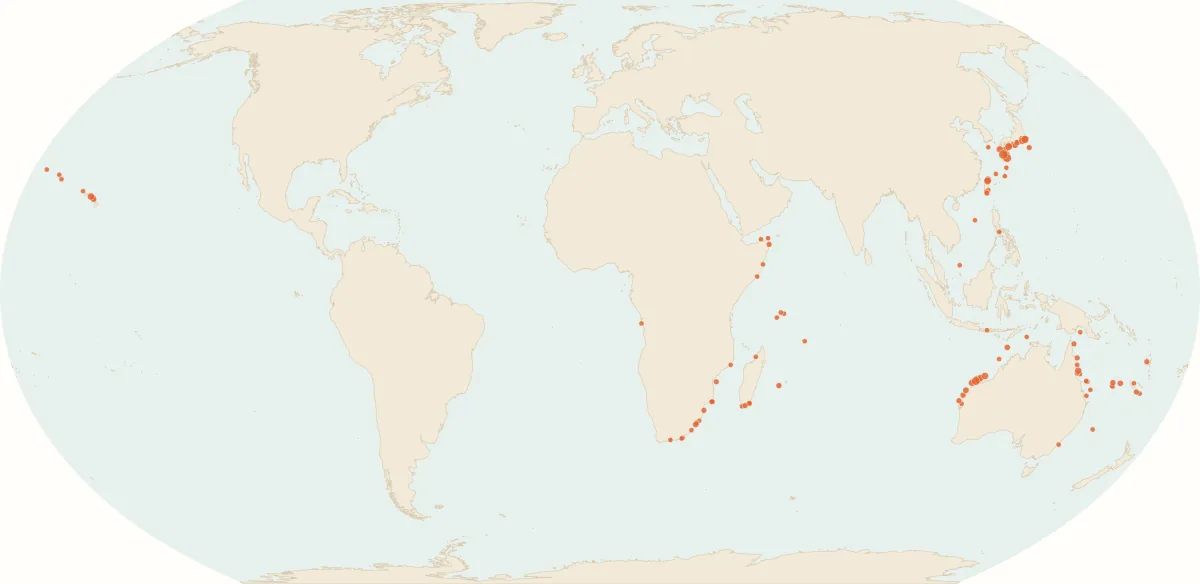
Records: GBIF.org (CC0 and CC BY 4.0 records, retrieved 2026-11-07). Map: Natural EarthSee the records on GBIF
Watch wild animals from a distance. Do not touch or feed them, and take care of the places where they live.
Names around the world
- 日本語
- キタマクラ
- 简体中文
- 水纹尖鼻鲀
- 繁體中文
- 水紋尖鼻魨
- 한국어
- 청복
- Español
- Tamborón ocellado
- Français
- Canthigaster à Bandes
- Português (Brasil)
- Baiacu-anão-bronzeado
Names come from Wikidata and iNaturalist records. Where a language has no recorded name, we use the scientific name.
Sources and how we check
- 鳥羽水族館 — キタマクラChecked: 2026-11-04
- 海響館 — No,003:キタマクラChecked: 2026-11-07
- 宇久井ビジターセンター — キタマクラChecked: 2026-11-07
- 東京都公園協会 — キタマクラChecked: 2026-11-07
We check each fact against its source. The illustrations simplify how the real animal looks.
The classification (class, order, family, genus) follows Wikidata records, checked against GBIF. Classifications can change as research goes on.
The basic data are the values given in each source. They vary with how the animal is measured, whether it is male or female, and whether it lives in the wild or in captivity.
This page was translated from the original Japanese with the help of AI.
Report a mistakeRELATIVES
Others in Tetraodontidae


MORE TO MEET


