Japanese angelshark

No sign-up needed. You can save notes on this device.
An illustration based on the real animal.
A little discovery to share.
The Japanese angelshark has spines along the middle of its back.
THE REAL WORLD
The real Japanese angelshark
- Scientific name
- Squatina japonica
- Japanese name
- カスザメ
- Group
- Ocean animals
- Class
- Chondrichthyes
- Order
- Squatiniformes
- Family
- Squatinidae
- Genus
- Squatina
A kind of shark that lives in the seas around Japan and off the Korean Peninsula and the East China Sea coast of China.
Basic data
- Diet
- Small fish and other prey
- Range
- Seto Inland Sea, Okinawa Islands, Korean Peninsula, Yellow Sea, Chinese East China Sea coast, and Peter the Great Bay, and elsewhere
- Conservation status in Japan
- Near Threatened (NT)Ministry of the Environment of Japan, Marine Red List (2017)
Where the Japanese angelshark has been recorded
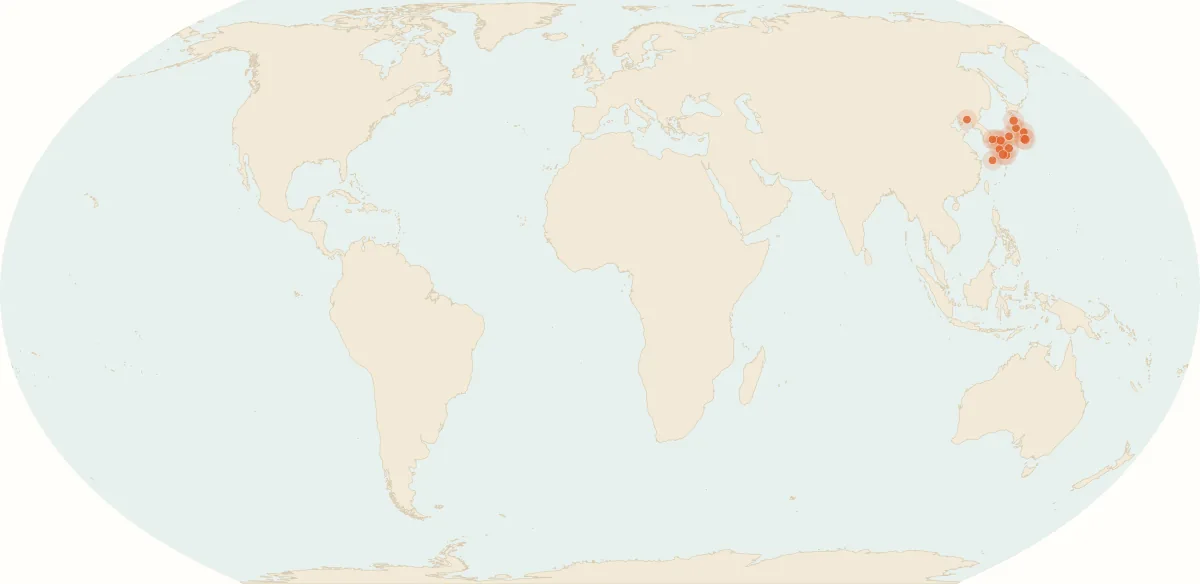
Records: GBIF.org (CC0 and CC BY 4.0 records, retrieved 2026-11-07). Map: Natural EarthSee the records on GBIF
Watch wild animals from a distance. Do not touch or feed them, and take care of the places where they live.
Names around the world
- 日本語
- カスザメ
- 简体中文
- 日本扁鲨
- 繁體中文
- 日本扁鯊
- 한국어
- 전자리상어
- Español
- Angelote japonés
- Français
- Ange de Mer Kasuzame
- Deutsch
- Japanischer Engelhai
- Italiano
- Squalo angelo giapponese
- Tiếng Việt
- Cá mập thiên thần Nhật Bản
- Русский
- Японская скватина
Names come from Wikidata and iNaturalist records. Where a language has no recorded name, we use the scientific name.
Sources and how we check
- 鳥羽水族館 — カスザメChecked: 2026-11-04
- 三重県水産研究所 — おさかな雑録 No.59 カスザメChecked: 2026-11-07
- Ministry of the Environment of Japan, Marine Red List (2017)Checked: 2026-11-07
We check each fact against its source. The illustrations simplify how the real animal looks.
The classification (class, order, family, genus) follows Wikidata records, checked against GBIF. Classifications can change as research goes on.
The basic data are the values given in each source. They vary with how the animal is measured, whether it is male or female, and whether it lives in the wild or in captivity.
The conservation status in Japan is the category in the Red Lists of the Ministry of the Environment of Japan, which assess the risk of extinction for wild animals in Japan.
This page was translated from the original Japanese with the help of AI.
Report a mistakeMORE TO MEET


