Goatsbeard brotula
Amazing fact
The goatsbeard brotula produces sound using the swim bladder inside its body.
Université de Liège
No sign-up needed. You can save notes on this device.
An illustration based on the real animal.
A little discovery to share.
The goatsbeard brotula produces sound using the swim bladder inside its body.
THE REAL WORLD
The real Goatsbeard brotula
- Scientific name
- Brotula multibarbata
- Japanese name
- イタチウオ
- Group
- Ocean animals
- Order
- Ophidiiformes
- Family
- Ophidiidae
- Genus
- Brotula
It lives on coral reefs and in seaweed beds, and is found widely from the coasts of Japan across the Indian and Pacific Oceans.
It has barbels on both its upper and lower jaws, and its dorsal, tail and anal fins are joined together.
How the Goatsbeard brotula lives
It is active at night. It eats shrimp, crabs and fish, among other prey. It also lives on rocky reefs and nearby sandy seabeds.
Université de LiègeSmithsonian Tropical Research InstituteBasic data
- Range
- Indo-Pacific, and elsewhere
Where the Goatsbeard brotula has been recorded
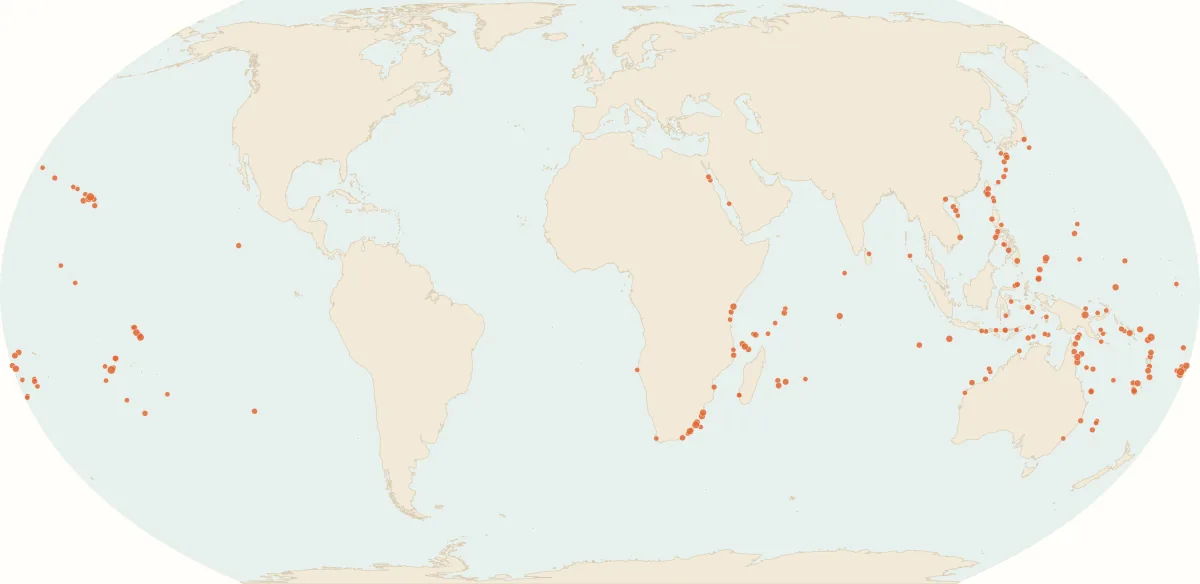
Records: GBIF.org (CC0 and CC BY 4.0 records, retrieved 2026-11-07). Map: Natural EarthSee the records on GBIF
Watch wild animals from a distance. Do not touch or feed them, and take care of the places where they live.
Names around the world
- 日本語
- イタチウオ
- 简体中文
- 多须须鼬鳚
- 繁體中文
- 多鬚鼬魚
- Français
- Brotule barbe-de-boue
- Português (Brasil)
- Brotula-do-Pacífico
- Italiano
- Brotola
- العربية
- بورتولا ذو لحية الماعز
- Русский
- Многоусая бротула
Names come from Wikidata and iNaturalist records. Where a language has no recorded name, we use the scientific name.
Sources and how we check
- 鳥羽水族館 — イタチウオChecked: 2026-11-04
- Smithsonian Tropical Research Institute — Species: Brotula multibarbata, Goatsbeard brotulaChecked: 2026-11-07
- Université de Liège — From soundscape to species: identifying Brotula multibarbata as the source of a reef sound with conservation implicationsChecked: 2026-11-07
We check each fact against its source. The illustrations simplify how the real animal looks.
The classification (class, order, family, genus) follows Wikidata records, checked against GBIF. Classifications can change as research goes on.
The basic data are the values given in each source. They vary with how the animal is measured, whether it is male or female, and whether it lives in the wild or in captivity.
This page was translated from the original Japanese with the help of AI.
Report a mistakeMORE TO MEET


