Red stingray
Amazing fact
The belly and tail of a red stingray offer clues for telling it apart from similar relatives.
海遊館
No sign-up needed. You can save notes on this device.
An illustration based on the real animal.
A little discovery to share.
The belly and tail of a red stingray offer clues for telling it apart from similar relatives.
THE REAL WORLD
The real Red stingray
- Scientific name
- Hemitrygon akajei
- Japanese name
- アカエイ
- Group
- Ocean animals
- Class
- Chondrichthyes
- Order
- Myliobatiformes
- Family
- Dasyatidae
- Genus
- Hemitrygon
Basic data
- Range
- East Asia
Where the Red stingray has been recorded
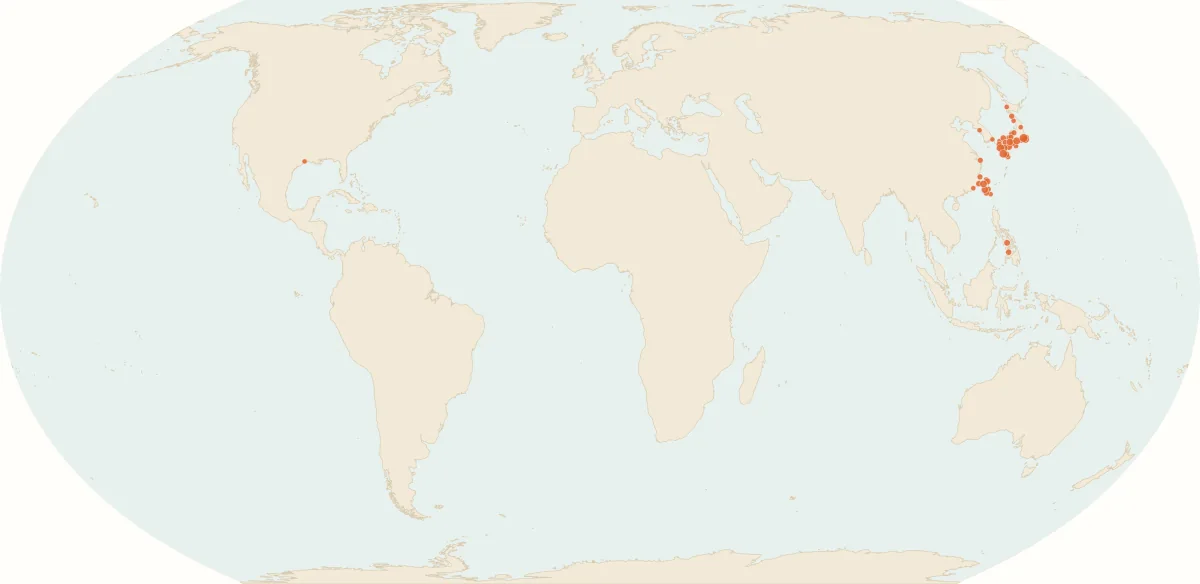
Records: GBIF.org (CC0 and CC BY 4.0 records, retrieved 2026-11-07). Map: Natural EarthSee the records on GBIF
Watch wild animals from a distance. Do not touch or feed them, and take care of the places where they live.
Names around the world
- 日本語
- アカエイ
- 简体中文
- 赤魟
- 繁體中文
- 赤魟
- 한국어
- 노랑가오리
- Español
- Raya roja
- Deutsch
- Japanischer Stechrochen
- Italiano
- Pastinaca rossa
- Bahasa Indonesia
- Pari merah
- Русский
- Дальневосточный хвостокол
Names come from Wikidata and iNaturalist records. Where a language has no recorded name, we use the scientific name.
Sources and how we check
- 海遊館 — アカエイChecked: 2026-11-03
- 鳥羽水族館 — アカエイChecked: 2026-11-03
We check each fact against its source. The illustrations simplify how the real animal looks.
The classification (class, order, family, genus) follows Wikidata records, checked against GBIF. Classifications can change as research goes on.
The basic data are the values given in each source. They vary with how the animal is measured, whether it is male or female, and whether it lives in the wild or in captivity.
This page was translated from the original Japanese with the help of AI.
Report a mistakeRELATIVES
Others in Dasyatidae


MORE TO MEET


